Sustained enterprise ROI has never come from a single person, a single team, or one swim lane. This was true long before AI — and AI actually makes it more true than ever.
More agents often just means more token bills and more headaches. The real fix isn’t throwing more AI at the problem. It’s multiplayer orchestration — AI 3.0.
What is Multiplayer Orchestration?
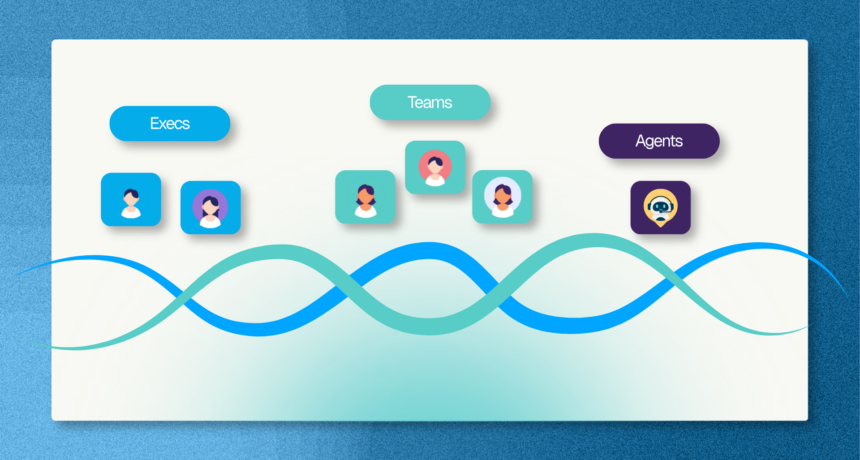
Multiplayer orchestration is bigger than multi-agent systems. While multi-agent setups are agents talking to other agents, multiplayer orchestration connects executives, teams, and their agents — both within teams and across teams — on a shared foundation.
It’s coordinated intelligence where human judgment, creativity, and strategic intent stay central. It also draws an important line: orchestrating operations (the full flow from strategy to execution) versus orchestrating tasks (narrow agentic automation). Most tools today do the latter. Multiplayer orchestration does the former.
The Real Problem AI Is Making Worse
Before AI, companies already struggled with information and context asymmetry — between executives and teams, and across teams. Strategic intent would decay through layers of handoffs, meetings, and decks. Translation errors were inevitable.
AI didn’t fix this. In many cases, it amplified the disconnect. Personal agents and AI teammates work in isolated contexts, creating more fragmented outputs, duplicated effort, and noisy misinformation.
Simply adding more agents doesn’t solve the problem. You need a system that keeps intent alive from the top down and across functions.
Why Multiplayer Orchestration is the Leap to AI 3.0
As AI evolves from AI 1.0 (chat and summarization) to AI 2.0 (specialized teammates), AI 3.0 is multiplayer orchestration. It connects executives, teams, and agents so that human judgment and creativity interweave with automation at every level — from macro strategy to micro execution.
Only then can organizations move beyond pilots and token-maxing experiments to achieve real, sustained enterprise ROI.
How Do You Move from AI Pilots to Real Enterprise ROI?
Most companies are stuck in the “more agents = more problems” phase:
- Stage 1: Personal / Free Agents — Quick individual wins, but expensive repeat offenders that reprocess the same data over and over.
- Stage 2: Dedicated AI Teammates — More capable, yet they break the moment they need input from another team.
- Stage 3: Multiplayer Agentic Orchestration — Executives and teams, working across functions with their agents, finally operate from shared, live context.
How Can You Scale Agents Without Exploding Token Costs?
By making them smart about what they compute — using a single source of truth instead of starting from scratch every time.
Example 1: The QBR Miracle
A Customer Success Manager used to burn serious tokens chasing Product updates. Now they simply ask in Teams:
- “What are Acme Corp’s open feature requests?”
- “If we prioritize this, what breaks elsewhere?”
The system delivers traceable answers, impact charts, and trade-offs — because the heavy context work was done once.
Example 2: Deciding a New Initiative
A big idea lands. Instead of weeks of fragmented meetings, revenue, product, and tech teams pull from the same live context. They bring their instincts and creativity while the orchestration layer handles the factual backbone. Discussions sharpen. Decisions accelerate. Execution actually happens.
What Does It Actually Take?
You need a living product operating ontology — a digital twin of how your business really works (goals, customers, dependencies, rules, and all the messy relationships in between).
This becomes the shared brain. Ambient agents keep it clean and current. Humans and AI agents both operate from truth, not guesswork.
The payoff is real:
- Cost Efficiency — Stop repeating expensive inferences.
- Speed & Agility — See ripple effects before they bite you.
- Reliability & Governance — Trust the data because you can trace it.
- Scalability — Every new agent gets smarter for “free.”
Product teams (the original cross-functional chaos creatures) love it most, but the model scales beautifully across the entire company.
Ready to move beyond herding AI cats?
Explore how Dragonboat’s Multiplayer Orchestration layer can help. Watch a video or talk to one of our product experts.