What Is Product Operating Ontology?
Ontology is a system that represents what exists, how it relates, and how those relationships govern action. Previously used primarily in academia, the concept of ontology was popularized in enterprise software by Palantir.
Product operating ontology is a “digital twin” of your product operating model. More than a database, more than a semantic layer, more than a graph — the live operating memory that humans and agents reason on and act against.
Why Is Ontology Non-Negotiable for Agentic PDLC?
Product is the hardest function to orchestrate with AI.
- It interacts with every other function — engineering, sales, marketing, customer success, finance, operations, legal, and people — simultaneously, in both directions.
- Its participants — from executives to product teams and stakeholders — translate strategy into work and customer signals into investment decisions, navigating trade-offs across teams where decisions are rarely unilateral.
- Its decisions, actions, and consequences live across dozens of systems, none of which agree on what anything means.
At scale: thousands of people, hundreds of agents, and millions of interconnected decisions and changes moving faster than anyone can manually reconcile.
Humans navigate that complexity through experience, conversation, and judgment. Agents can’t. For agents to operate reliably across the PDLC, every one of the following has to be true.
Miss one and that gap gets filled by inference — and at the rate agentic operations change, inference drifts, drift disconnects, and disconnect costs.
- Must hold every object that matters to your PDLC (Purpose-built) — strategy, investment, allocation, customer, product, roadmap, work, outcome, and more. A work tool holds work, a CRM holds customers, a PM tool holds products and roadmaps. Each covers a slice, and agents infer the rest — less reliably with each hop.
- Those objects need shared meaning across every tool and workspace (Unified Semantics) — so Customer A in one tool and Account 123 in a Jira field resolve to the same object. Adding Jira Product and Jira Strategy collections to Jira work creates more objects, but not shared meaning. Point syncs move records rather than establish what they mean. Truth assembled fresh on every query isn’t truth — it’s a guess with good latency.
- The relationships between objects must be explicit and traversable (Operating Graph) — objects only become useful when agents can trace what connects to what: a delayed feature to the customer commitment it affects, and to the dependency causing it. Planning and tracking tools model hierarchy, not cross-domain relationships, so upstream intent and downstream impact stay invisible.
- Operating rules must be encoded and enforceable (Domain Rules) — related objects only become operable when the logic governing them lives in and evolves with the system. Vibe-coded apps and automations execute steps but carry no domain intelligence, making maintenance expensive and brittle.
- Governance must be at object and attribute level for agents (ABAC permissions) — project-level and role-based permissions were built for humans navigating screens; agents reading and writing across the operating model need granular control per object and attribute to be production ready.
- Every action must write back and propagate (Close the Loop) — governed action only counts if it changes state everywhere. LLMs summarize and recommend, but the update never reaches connected systems, so the next decision runs on stale data and the operating model never moves.
Together, these six give the operating model something no tool combination can assemble: Memory. Shared, persistent, and traceable.
That memory is what makes continuous eval possible — reality measured against intent on every change, so drift and risks are detected before they escalate.
What Does This Mean for Your agentic PDLC?
Ontology is not a feature of an advanced agentic system. It is the prerequisite.
Without it, agents hallucinate. Governance collapses at scale. Domain context gets rebuilt from scratch on every interaction. The operating model loses coherence the moment it moves faster than humans can manually synchronize.
With it, humans and agents share the same operating reality. Decisions are made in context. Governance holds. The system gets smarter as it operates.
If you’re building an agentic PDLC, the question isn’t whether you need ontology. It’s whether your platform has one that’s worth running on.
See how a Fortune 500 fintech put this into practice: Agentic PDLC Transformation with Dragonboat.
Appendix: The Six Elements of an Active, Operating Ontology
The six non-negotiables above are what the ontology must deliver. Here’s what it’s made of.
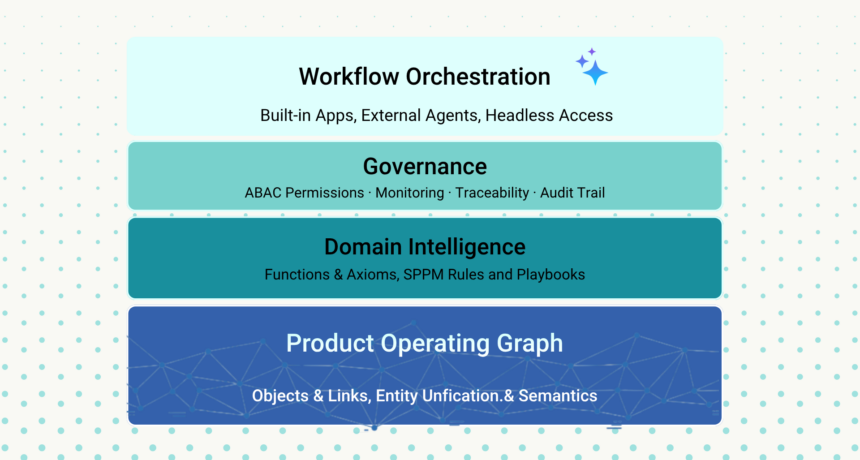
Ontology is often used interchangeably with taxonomy, data model, or knowledge graph — but it is more than each of them individually. A full active ontology is operational, and has six elements:
- Objects & Links, aka data models and relationships, or nodes and edges in a graph data model. Creates a digital twin of the operating model for real-world entities like “Goals,” “Capabilities,” and “Customers” and the explicit connections between them.
- Entity Resolution & Semantic Unification, aka binding meaning across systems — where a graph becomes a knowledge graph. The hard work of taking “Customer A” from Salesforce and “Client 99” from an internal database and programmatically collapsing them into a single unified entity in the operating graph.
- Functions & Axioms, aka domain and operating rules and logic. Ensures relationships are not just lines on a graph but enforceable business logic — if current progress is 10% behind expected, automatically flag “Feature Health” as off track.
- Action Orchestration / Workflows, aka Runbooks, Playbooks, and Tool Orchestration. Turns the data graph into a “tool factory” — both human operators and AI agents can execute multi-system workflows safely using the ontology’s exact semantic coordinates.
- Dynamic Governance & Security, aka access control and change management. Permissions, compliance rules, and audit trails applied at the entity level — evolving with the organization, not bolted on at the perimeter.
- Closed-Loop Write-Back, aka read and write, decide and act. Every action propagates back into connected systems, so the next decision is made on updated reality — what distinguishes an operational system from an analytical one.
Together, these six elements turn a data model into an operating system.
—
Evaluating a platform for your agentic PDLC? The 10 questions to ask — on truth, governance, domain intelligence, and more — are a good place to start.