10 Questions to Ask
Enterprise reality changes with every action in the operating model. With AI, the pace of change—and therefore the rate at which intent drifts and context decays—accelerates dramatically. This makes the platform running the agentic PDLC more consequential than ever.
So how do you choose one?
There is a clear pattern: serious evaluations are moving away from “which AI is smartest?” toward workflow coverage, context and data, governance, integrations, observability and evals, human oversight, and the ability to operate in the real enterprise. (McKinsey & Company).
So don’t evaluate the demo. Evaluate whether the approach can actually run the PDLC.
Ask 10 questions:
- Humans + agents — Are both first-class participants?
- Ontology for end-to-end PDLC — Does the ontology cover the complete PDLC across strategy, insight, investment, product, portfolio, intake, delivery, and outcomes?
- True truth — Does it provide a true reflection of operating reality—live data, verified lineage, unified semantics, shared context, and operating rules—kept live and actionable?
- Domain intelligence — Does built-in and learned intelligence help run the PDLC, or do you have to build and learn everything yourself?
- Governance — Can access and actions be governed at object and attribute level?
- Time to value — Can you start with existing data and evolve the operating model without a massive big-bang implementation?
- Toolstack — Can it integrate deeply and contextually with today’s and tomorrow’s systems, agents, and models?
- Users + interactions — Can everyone, including agents, access and interact with it where they work, with increasingly proactive participation?
- Extensibility — Can you use what’s built in while bringing, building, and combining other agents and applications?
- Proven — Has it run the PDLC at enterprise scale—and through real change?
The ultimate question:
Does it accelerate the entire PDLC toward intended outcomes at the speed AI enables?
We unpack all 10 questions—and what good looks like—in the full guide.
1. Can it support humans and agents as first-class participants?
Why:
The product operating model has always been multiplayer—and AI makes it even more so. Decisions and actions involve multiple humans and their agent partners working together to decide, act, and adjust, rather than humans merely inspecting what autonomous agents have done.
Questions to ask:
- Can humans and agents operate together on the same product reality?
- Are there effective tools and experiences for both humans and agents—not just a chat interface that can’t drill down, change, or adjust?
- Can humans and agents work in real time, asynchronously, and through automation?
- When agents decide and act on behalf of their human partners, are the resulting changes, decisions, and traces reflected in the shared product reality?
- Can a human seamlessly take over, intervene, approve, or redirect an agent without breaking the workflow?
Common gaps:
- Traditional product platforms with AI bolted onto a human-centric application.
- AI copilots that can answer but cannot inspect, reason across, or change the underlying model.
- Autonomous agent platforms where humans are primarily exception handlers.
- Agents operating in a separate context from the systems humans use.
The good — Dragonboat:
Humans, embedded ambient agents, and external agents operate as first-class participants against the same live product reality—with built-in experiences for people and headless access through MCP/APIs for agents, so they can read, drill down, reason, act, write back, and maintain traceability.
2. Does it support the entire AI PDLC—with the domain depth to operate it?
Why:
An AI-PDLC is not simply the existing PDLC with AI features added. Operating across the full lifecycle requires an underlying ontology of domain objects, relationships, logic, and rules—so humans and agents have the context and operating model to work across interconnected stages. (Slalom on AI-PDLC)
The test:
Can the platform maintain continuity from opportunity → strategy → discovery → investment → planning → delivery → launch → outcome → learning—and beyond?
Questions to ask:
- Does it support the full product operating model, with domain depth across Product Management, PPM, and SPM?
- Does its underlying ontology represent the domain objects, relationships, logic, and rules needed across the PDLC?
- Does each stage have the relevant context, state, triggers, actions, and stopping conditions for humans and agents?
- Can intent, context, decisions, and learning carry forward across interconnected stages and dependencies?
- When something changes, can it trigger the next decision or action?
Common gaps:
- Product, roadmap, work, or PPM tools that cover only part of the PDLC—or require significant customization to cover more.
- Adding AI features or agents to existing workflows without an underlying AI-native product operating model.
- “End-to-end” platforms that connect point features and integrations but lack the domain ontology and operating logic to run the full PDLC.
The good — Dragonboat’s AI-native product operating model:
Dragonboat is an ontology-native platform purpose-built for the product enterprise to operate at speed, scale, and complexity. Its active ontology encodes the domain objects, relationships, logic, and rules across the full product operating model, with domain depth across Product Management, PPM, and SPM. This gives humans and agents the shared context, state, triggers, actions, and stopping conditions to reason, decide, act, evaluate, and adapt across the AI-PDLC—from opportunity through outcomes and into the next cycle.
3. How TRUE is the truth the platform enables?
Why:
Agents are only as reliable as the reality they operate on. Canonical data, semantics, lineage, and governance are increasingly being treated as prerequisites for reliable agents. (Deloitte).
Truth isn’t merely data records that are updated. A graph is not necessarily truth. A semantic layer is not necessarily truth. AI inference is not necessarily truth.
Truth requires the platform to connect data, ensure records are updated, and establish what things mean, which relationships are authoritative, where information came from, whether it is current, and how changes become part of the shared reality.
The test:
Can humans and agents inspect, verify, reason over, and act on a live product reality where semantics, relationships, provenance, and changes are explicit—not simply inferred?
Questions to ask:
- Is data connected across systems and continuously kept current?
- Are entities and relationships semantically unified, rather than inferred differently by each AI interaction?
- Which source is authoritative, and is provenance/lineage visible?
- Can humans verify and correct inferred relationships or changes?
- When reality changes, does the change propagate—and can the system write the new reality back?
Common gaps:
- “Our AI can summarize all your data” — retrieval and inference without an authoritative product reality.
- “We have a graph / can trace changes and build agents” — connections without a unified semantic model and domain meaning.
- “We are a semantic layer that uses AI to understand your operating model” — inference rather than encoded, verifiable product semantics.
The good — Dragonboat:
Dragonboat’s Truth Layer uses an active ontology to create live shared context with unified semantics, PDLC domain relationships, rules, scenarios, provenance, and source-of-truth operations—so humans and agents can verify, reason over, act on, and write back to the same product reality.
4. What domain intelligence does it bring to help us learn and improve?
Why:
A basic platform automates work. A domain-intelligence-powered PDLC platform continuously applies encoded and enriched best practices—evaluating reality and trajectory against intent, identifying risks, drift, and opportunities, and helping humans and agents learn and improve.
The test:
Does the platform continuously apply domain expertise to evaluate, learn, and improve how the PDLC operates?
Questions to ask:
- What product-domain expertise is encoded in the platform?
- Is that expertise continuously enriched by what happens in our product operating model?
- Can it evaluate reality and trajectory against intent, detect drift and risk, and identify what matters?
- Can it suggest actions or adjustments based on domain context?
- Does what it learns become part of the operating model for future decisions and actions?
Common gaps:
- Generic AI that can analyze or summarize, but has little embedded product-domain expertise.
- Static best-practice frameworks that don’t continuously learn from the operating environment.
- Monitoring and analytics that surface changes without evaluating what they mean or what to do next.
The good — Dragonboat:
Dragonboat’s Intelligence Layer combines encoded product-domain expertise, active ontology, and ambient agents to continuously evaluate reality and trajectory against intent, surface risks and ripple effects, and suggest adjustments—while continuously enriching the operating model with what the organization learns.
5. How granular and maintainable is governance across people, agents, data, and actions?
Why:
In an effective agentic operating model, humans and agents need to read, write, and take action—not just observe. That makes governance at the object and attribute level critical, along with approvals, logging, and monitoring. At scale, this requires an ontology that reflects the actual operating model; otherwise, attribute-based access and action controls become too complex to define and maintain.
The test:
Can governance follow the operating model at the level of the object, attribute, person, agent, and action—and remain manageable as the model evolves?
Questions to ask:
- Can access and action permissions be governed at the object and attribute level?
- Can policies distinguish what different humans and agents can read, write, decide, and act on?
- Can actions require approvals where appropriate, with clear escalation and intervention?
- Are agent and human actions logged and monitored with full traceability?
- Can these controls be maintained as the ontology, organization, workflows, and agents evolve?
Common gaps:
- Human-centric permissions extended to agents, without granular control over what agents can read, write, or do.
- Coarse role-based controls that don’t support object- and attribute-level governance.
- Attribute-based governance without an underlying ontology, making policies brittle and difficult to maintain at scale.
The good — Dragonboat:
Dragonboat’s Governance Layer, built on its ontology, provides the semantic foundation for granular, maintainable governance across people, agents, objects, attributes, data, and actions—with least privilege, approvals, logging, monitoring, and auditability built into the operating model.
6. What’s the time to value, change management, and ongoing maintenance required?
Why:
An agentic platform needs to quickly leverage the data you already have—structured and unstructured—while allowing the operating model to evolve quickly. It should support inferred context with human validation, accommodate different ways of working, and minimize both initial and ongoing change management.
The test:
Can the platform selectively and incrementally build a useful operating model from existing data, while letting humans validate the reality and continuously adapt the model as the organization changes?
Questions to ask:
- Can it quickly leverage existing structured and unstructured data without requiring a massive data-entry project?
- Can it infer the operating model from existing data while allowing humans to validate, correct, and shape it toward the desired state?
- Can the ontology remain elastic as products, teams, processes, and ways of working change?
- Can autonomous teams use the platform without having to fundamentally change their existing operating habits?
- How much ongoing effort is required to maintain the data model, semantics, rules, and workflows?
Common gaps:
- AI platforms that simply infer a model from messy data—potentially codifying the wrong reality rather than helping establish the desired one.
- Custom-built tools and applications that require significant setup, trial and error, and ongoing maintenance—and become brittle as the operating model changes.
- Rigid platforms that require teams to change how they work to fit the system.
The good — Dragonboat:
Dragonboat’s Elastic Ontology foundation makes the operating model elastic and scalable. It can selectively leverage existing structured and unstructured data, infer context, incorporate human validation, and adapt as the organization evolves—without requiring teams to rebuild their ways of working or continuously maintain a brittle custom system.
7. How does it fit our existing—and evolving—technology ecosystem?
The AI-PDLC is connected to all aspects of the enterprise—and therefore to its tools, agents, systems of action, and systems of record. Each function has its own technology stack, and every stack is evolving with new models, agents, applications, and ways of working.
The test:
Can it securely connect to what we use today—and flex with what we add tomorrow—without losing the context that connects the enterprise?
Questions to ask:
- Does it connect securely to our existing systems of record, revenue tools, work tools, and data platforms?
- Do integrations preserve the context and semantics of what is being connected, rather than simply moving data?
- Can humans and agents both read from and write back to connected systems?
- Can new agents, models, vibe-coded apps, and internal tools connect without waiting for a new vendor-built integration?
- Does the integration surface support both current and future ways of working?
Common gaps:
- Connector catalogs that move data but lose the context, relationships, or meaning around it.
- Integrations designed primarily for sync/import rather than contextual, two-way read and write.
- Closed integration models that struggle to accommodate new agents, applications, and tools as the ecosystem evolves.
The good — Dragonboat’s contextual integration gateway:
Dragonboat’s contextual integration gateway connects the product operating model to the enterprise ecosystem, providing secure, contextual read/write access across systems of record, systems of action, agents, and applications through native integrations, APIs, and MCP.
8. How easy is it for everyone to participate?
Why:
An AI-PDLC involves many participants—from executives and teams to go-to-market teams, operations, and their agents—but they shouldn’t all have to become expert users of another enterprise application. People should be able to work from where they already work, while the platform brings them the relevant context, alerts, decisions, and actions they need.
The test:
Can light users, executives, and their agents participate from where they already work and get trusted, contextual answers and actions—without constantly checking another system?
Questions to ask:
- Can people participate from where they already work, such as Slack, Teams, email, or their preferred AI assistant?
- Can the platform proactively bring the right context, alerts, and requests to the people who need them?
- Can users respond, decide, and take action without always opening the core application?
- Can agents and automation handle routine follow-up so people don’t have to constantly check in and maintain the system?
- When deeper context is needed, can users drill down seamlessly into the underlying product reality?
Common gaps:
- Enterprise applications that require everyone to log in, learn the workflow, and keep records updated.
- Chat interfaces that make access easier but don’t provide real drill-down, decision, or action capabilities.
- Notification and automation layers that push information but don’t provide the contextual ability to understand and act on it.
- MCP without a trusted substrate: An MCP connection can make a system accessible to an agent, but accessibility doesn’t make the underlying answers trustworthy. Without a semantic system of truth, results can still be inferred, inconsistent, or impossible to trace.
The good — Dragonboat’s headless participation:
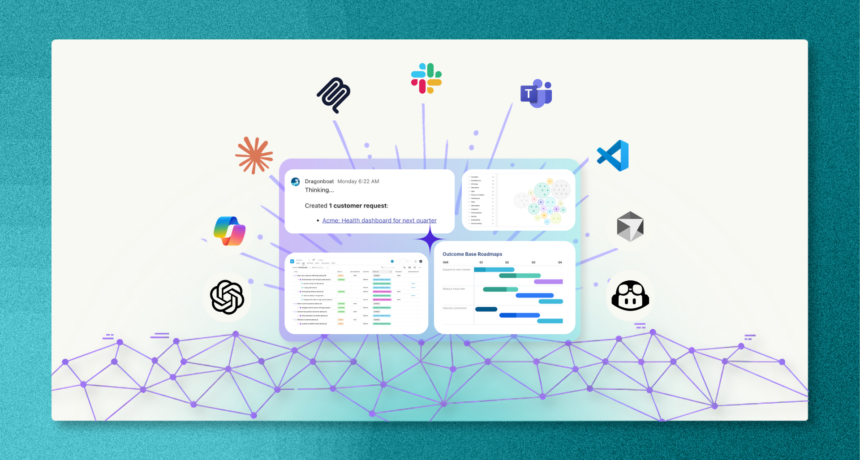
Dragonboat’s headless access, in addition to built-in apps, lets people and agents participate from where they already work, through Slack, Teams, LLMs/Copilot, MCP, embedded, and other headless interfaces—while Dragonboat brings context, alerts, decisions, and actions to them. When deeper understanding is needed, participants can drill down into the same underlying product reality.
9. What agents come with it—and what agents can I build on it?
Why:
As organizations’ agents and other operating capabilities vary and evolve, an AI-PDLC platform needs to provide both out-of-the-box capabilities and the freedom to build, bring, replace, and combine what works best for the organization.
The test:
Can we use what comes out of the box, bring what we already have, and build what we need—all on the same operating foundation?
Questions to ask:
- What embedded agents come out of the box for product jobs to be done?
- What ambient agents continuously maintain, evaluate, and enrich the operating model?
- Can we bring external agents and have them read, reason, act, and write against the same ontology?
- Can we build our own agents, internal tools, and vibe-coded applications on the platform?
- Can we replace or combine capabilities without breaking the underlying product reality?
Common gaps:
- AI platforms where the vendor’s agents are the product and the primary path to value.
- “Open” platforms that allow agents to connect but don’t provide the semantic operating foundation they need to reason and act reliably.
- Custom-build platforms where every new agent or application requires rebuilding its own context and operating model.
The good — Dragonboat’s active operating substrate:
Dragonboat offers an active operating substrate, not a vendor of agents. It provides embedded agents and ambient agents out of the box, while its open platform lets enterprises bring, build, replace, and combine agents, internal tools, and vibe-coded applications—all operating against the same elastic ontology.
10. Is the solution mature enough for enterprise-scale operation?
Why:
AI-PDLC becomes a critical operating and strategic platform for the business, where the cost of experimentation can far exceed the cost of the tool itself. The platform and vendor need proven scale and sustained enterprise-wide operation—with the breadth and expertise to support evolving operating models, new technologies, and increasingly agentic ways of working.
The test:
Is there referenceable evidence of sustained, enterprise-scale (think tens of thousands of teams and millions of signals) AI-PDLC operation—across people, products, systems, and evolving technology—beyond pilots, design partners, limited-scope or team adoption, or legacy tools with AI feature add-ons?
Questions to ask:
- Is it deployed and adopted enterprise-wide, with sustained usage over multiple years—not just a pilot or a single team?
- What performance and scale has it demonstrated—tens of thousands of active users, millions of signals, and large volumes of interconnected data?
- Does it work across a broad range of enterprises, products, and technology ecosystems?
- Does the vendor have deep product-domain expertise and the technical and customer-support capabilities to operate at this scale?
- Can they provide referencable customers with quantified outcomes sustained over time?
Common gaps:
- New platforms with impressive demos but limited production deployment, pilots, or design partners.
- Mature legacy platforms with enterprise scale, but limited evidence of an AI-native operating model.
- General-purpose tools proven for individual teams or isolated use cases, rather than enterprise-wide product operating models.
The good — Dragonboat’s enterprise maturity:
Dragonboat has proven enterprise-scale deployment across thousands of teams and a wide range of companies and technology ecosystems, with sustained usage, large volumes of product and engineering signals, referencable customers, and a team with deep product-domain expertise.
A Summary
| # | Evaluate | Common gaps | What’s good — Dragonboat |
| 1 | Humans + agents | Human-in-the-middle or autonomous agents with humans as exception handlers. | Multiplayer agentic platform |
| 2 | End-to-end AI PDLC | Partial PDLC, customized work tools, or AI features bolted onto existing workflows. | Ontology-native AI-PDLC platform |
| 3 | “True” Truth | Connected or inferred data without unified semantics, provenance, verification, or write-back. | Truth Layer |
| 4 | Domain intelligence | Automation without encoded expertise or continuous evaluation against intent. | Domain Intelligence Layer |
| 5 | Governance | Coarse permissions, weak least privilege, or governance difficult to maintain at scale. | Governance Layer |
| 6 | Time to value | Massive data-entry projects, rigid models, or brittle custom applications. | Elastic Ontology Foundation |
| 7 | Toolstack | Point integrations, read-only connections, or inability to adapt as tools and agents evolve. | Contextual Integration Gateway |
| 8 | Users & interactions | Another application to learn, with limited headless or contextual participation. | Headless participation |
| 9 | Open / platform extensibility | Closed agent ecosystem or connectivity without a shared operating foundation. | Active Operating Substrate |
| 10 | Solution maturity | Pilots, design partners, limited-scope adoption, or legacy scale without AI-PDLC maturity. | Enterprise-scale AI-PDLC |
Winning in the AI era
The competitive advantage is how you operate with AI at speed and scale. The right platform can make or break an agentic enterprise.
A great AI demo isn’t enough. The platform running the AI-PDLC needs to pass a more exhaustive test, as outlined above.
The 10 questions above ultimately test one thing:
Can the platform enable the organization to achieve enterprise ROI at AI speed?
Why:
Fast execution does not automatically generate ROI. Without overall orchestration, AI-driven execution can create higher costs, more product debt, and escalating enterprise disconnect. The real advantage comes from accelerating the decision → action → outcome → learning loop, while continuously evaluating reality against intent to calibrate faster.
The test:
Does the platform create a faster intent → outcome → eval cycle while continuously accelerating the decision → action → outcome → learning loop across the product operating model?
This is where the 10 questions come together. The platform needs to provide the intent, truth, domain intelligence, governance, participation, toolstack connectivity, extensibility, and enterprise maturity required for humans and agents to operate as one system.
The good — Dragonboat’s OS for Agentic PDLC:
Dragonboat brings these capabilities together as an operating system for the agentic product operating model—grounded in an ontology-native foundation that gives executives, teams, and AI agents a shared, trusted context for strategy, investment, and execution.
It enables the organization to decide fast, act fast, evaluate fast, and adjust fast—continuously evaluating reality against intent and accelerating the path from decision to action, outcome, and learning.
That is what turns AI speed into enterprise ROI.
—
Ready to superpower your AI product operating model and accelerate enterprise ROI? Talk to us today.