Events • On Demand
Product & Portfolio Operations on Autopilot
Real examples of agentic automation that give PMs more time to think, learn, and create.
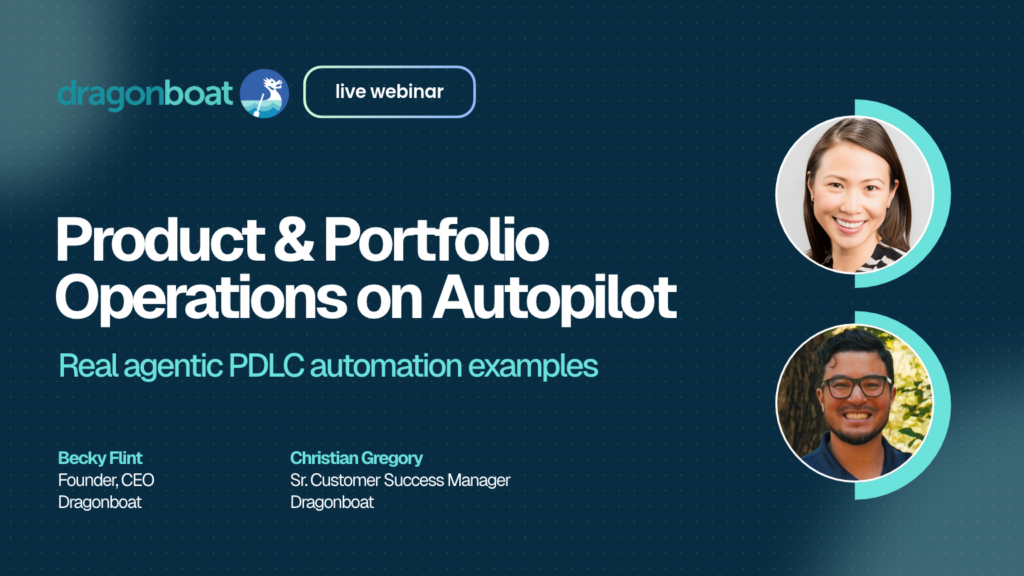
In this on-demand session, Becky Flint, Founder & CEO of Dragonboat, and Christian Gregory, Senior Customer Success Manager, share real examples of how product teams use agentic automation to take recurring work off their plates, from status updates and exec reporting to customer insights, metrics and release notes.
They also unpack why so many agents fall short, and what the teams getting it right do differently.
Designing an AI agent is actually the easy part—building one that works reliably without creating “AI slop” is where most teams fail. When AI agents rely on unguided inference across noisy Slack threads, emails, and raw tickets, hallucinations and context drift inevitably take over.
To build a reliable agentic operating model, (and prevent AI slop), product organizations must build their workflows on the three core pillars:
1. Map Your Distributed Vectors of Truth
No single platform holds 100% of your business context. Your CRM holds customer revenue, support tools hold ticket history, analytics platforms track usage, and product tools manage roadmaps. Successful AI agentic workflows don’t try to dump all raw data into one massive lake; they route decisions by knowing exactly which tool owns each vector of truth.
2. Achieve Semantic Unification
The exact same customer must be analyzed through different functional lenses across revenue, support, and product teams. Semantic unification establishes shared context, definitions, and memory across tools so AI agents receive the exact context required to perform the right job without semantic drift.
3. Establish a Product Decision Operating Graph
To prevent AI slop, agents must evaluate raw inputs against a structured product decision graph rather than re-inferring reality from scratch. Dragonboat serves as the single source of truth for product strategy, OKRs, insights, feature trade-offs, and outcome metrics. By connecting these entities and their associations, AI agents can evaluate trade-offs, detect roadmap drift, and execute operating chores while maintaining complete portfolio context.
💡 The Takeaway: When you connect distributed vectors of truth to a unified product operating ontology, AI agents stop guessing—and start empowering your team to decide, act, and adapt with speed and clarity
Want to go deeper?
- Book a free PDLC Automation Lab: bring one recurring job, and leave with an agentic workflow you can run.
- Explore more agentic use cases with Dragonboat MCP → dragonboat.io/mcp-agentic-flows
- See it in your workflow: Get a demo
Featured Speakers

Becky Flint
Founder, CEO at Dragonboat
Becky is a product and tech executive based in the Silicon Valley. She has built and scaled product and engineering teams globally for both startups and Fortune 500 companies. Currently Becky is the Founder and CEO of Dragonboat with a mission to empower responsive leaders and their teams to build better products faster. Prior to founding Dragonboat, Becky has held executive roles at Feedzai, Bigcommerce, Tinyprints/Shutterfly, and PayPal.

Christian Gregory
Senior Customer Success Manager | Dragonboat
Christian works side by side with Dragonboat customers every day, from onboarding to scaling agentic workflows across their product and portfolio operations. He brings real examples of how teams of all sizes put their operating work on autopilot.