Strategic Steering
Strategic steering is the ongoing executive practice of setting strategy, allocating investment, and adjusting course as new information arrives — distinct from a one-time annual planning exercise. It’s the “steer” and “adapt” side of the enterprise operating loop: leaders set direction, then continuously re-evaluate it against what teams are actually delivering and what market signals show.
That continuous comparison only works if strategy, investment, and execution live in one connected, living ontology instead of separate systems and decks — otherwise leaders are steering on information that’s already stale by the time it reaches them. This is where AI running quietly in the background — what Dragonboat calls an ambient agent — does the heavy lifting: it continuously watches for strategic drift and over- or under-invested initiatives, and flags them the moment they happen, so leaders can re-steer investment in real time rather than waiting for the next planning cycle to correct course.
Learn more in The Missing Layer Between AI and Enterprise ROI and the Strategic Portfolio Management solution.
Three Time Horizons
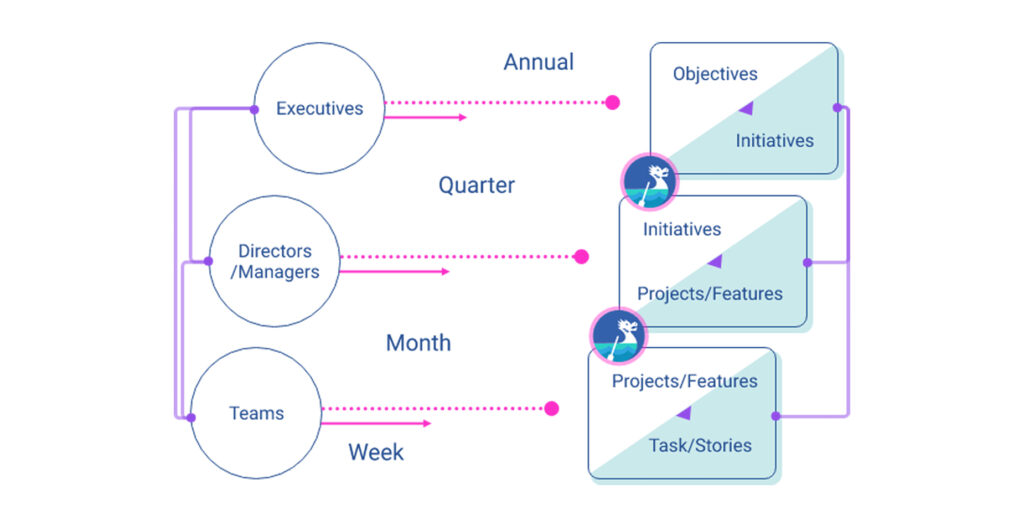
In Responsive Product Portfolio Management (Responsive PPM), product leaders and their teams take into account three different operating horizons that take place within a product-centric organization. Every organization has long-term, mid-term and near-term focuses and corresponding activities, led by the respective levels of the organization. The operating rhythm such as annual planning, quarterly planning and sprint planning ensue.
Responsive PPM connects the rolling time horizons across all levels to enable strategic alignment and operational autonomy between levels.
Top-Down Alignment
Top-down alignment refers to the practice where managers and executives set the overall strategy and goals for the organization. When paired with bottom-up innovation, teams are empowered to ideate, build, and deliver the best products possible for the customers and the business.
User Story
A user story is used in Agile development and is a short, informal, description of what a user wants to do within the software product. Its purpose is to articulate how a software feature will provide value to the customer. User stories typically follow the role-feature-benefit pattern: As a [type of user], I want [an action] so that [a benefit/value].
V2MOM
V2MOM is a goal-setting framework and alignment process that Salesforce founder and CEO, Marc Benioff, claims has been critical to its success. V2MOM is an acronym for Vision, Values, Methods, Obstacles, and Measures.
Benioff created the framework to help employees successfully convince others to align with their vision, prioritize effectively, and scale the process of setting priorities for 100s to 1000s of employees.
Velocity
Velocity reflects the speed of moving toward a destination, not just speed.
Here are a few concepts related to velocity:
- Scrum velocity: Measures the amount of throughput a scrum team can produce. It is usually measured as points per sprint or stories per sprint. This metric helps teams estimate their capacity and plan future sprints more effectively.
- Engineering velocity: Refers to the time it takes from starting the engineering process to releasing the product to customers. It reflects the efficiency of the engineering team in delivering working software. It does not include the time spent on planning, prioritization, or customer and business value realization period (go-to-market period). A related concept is the developer velocity index by McKinsey, which evaluates various factors related to engineering velocity. Learn more here.
- Product velocity: Also known as “Time to Market,” product velocity measures the time from when an idea is first conceived to when users start using it and gaining value. It reflects the efficiency of the entire product development lifecycle (PDLC). Since engineering is a key part of product development, engineering velocity directly impacts product velocity. Other factors that influence product velocity include strategy, portfolio management practices, product discovery and planning, and product launch effectiveness. It’s important to note that not all product ideas should achieve high velocity—some should fail fast and early to prevent wasted effort. This is where the concept of strategic velocity becomes relevant.
- Strategic velocity: In a high-performing product organization, strategic velocity is the speed at which a product team achieves the strategic outcome it aims to achieve with the resources available. A product organization may pursue various bets to reach its target outcomes—including big bets with high risk and high return, smaller and safer bets, or a combination of both. Deciding which bets to make, when to move forward or stop, and how to adjust resource allocation among these bets are key factors in driving strategic velocity. These decisions reflect responsive product portfolio management practices. Strategic velocity serves as a measure of a product leader’s effectiveness.
Waterfall Model
The Waterfall Model is a sequential methodology used for planning, building, and delivering software products and features in distinct phases. Each phase is completed before the next one begins. Typical phases include conception, initiation, analysis, design, development, testing, implementation, and maintenance.
Over time, Waterfall has taken a backseat to the Agile methodology as the preferred approach for software development.
Weighted Scoring
Weighted scoring is a prioritization method that allows you to gauge benefits against costs by assigning metrics to strategic initiatives to score them against each other. Popular product prioritization frameworks that use weighted scoring include MoAR, RICE, MoSCow, and Kano.
XP (Extreme Programming)
Extreme Programming (XP) is an agile software development methodology in which teams aim to produce working software in 1-2 weeks, rather than the usual 2-4 week iteration.
Year-Over-Year (YoY)
Year-Over-Year (YoY) is the statistical process of comparing one year of data to the same set of data from the previous year.
Zzz’s
Looks like section Z of the product portfolio management dictionary is catching some Zzz’s!
Have a term you’d like to see? Submit it here.
 Previous Page
 Looking to connect
with other product
leaders?