
The Pressure for Speed Has Never Been Higher
Market expectations, AI acceleration, and competitive pressure now demand faster decisions and faster outcomes.
Every role feels the strain, but in different ways:
- Executives see “execution does not reflect strategy.”
- Product Ops is herding cats with jetpacks, “aligning a context that’s probably already outdated.”
- Product Managers spend more time aligning decisions than shaping strategy.
- CEOs and CFOs gradually disengage from product decisions—not from lack of interest, but from lack of trusted, decision-ready data.
- Engineering feels blocked by planning cycles and believes “PM slows us down.”
- Sales and Marketing depend on product outcomes, yet operate with little visibility into tradeoffs, treating product as a black box and routing requests directly to engineering.
To address speed, teams adopt more tools, including AI point solutions. Context fragments further with every interaction. Decisions move faster locally, but slower across the organization.
Faster tools haven’t made teams faster.
The Innate Challenges in Running Products at Scale
Running Product at scale is fundamentally different from executing work. Work is often sequential and owned by individuals. Product is decision-driven, cross-functional, and continuous. These conditions naturally create information asymmetry and fragmented context, which introduces decision latency. At scale, speed becomes an infrastructure problem.
Setting Strategy Requires Learning From Past Bets
The current operating mode spans multiple systems and handoffs—pulling reports from Tableau, Power BI, or Domo, then manually overlaying product plans and investment bets. This effort-heavy process limits how often learning is applied in practice. When both executives and product managers need to set strategy at multiple levels—from company goals to feature bets—scattered insight increases the risk of strategic drift.
Understanding Customers and Revenue Takes More Than Signals
Teams need to decide which customers to serve, in what order, and at what tradeoff. Feedback, trends, and AI summaries help, but customer and revenue context live in systems like Salesforce, Zendesk, or Amplitude. Insight that isn’t evaluated alongside product and portfolio decisions doesn’t improve decision or outcome speed.
Product Decisions Get Inputs From (Too) Many
Product decisions get inputs from product, engineering, design, GTM, and leadership. Each function operates with a partial view shaped by its own systems and incentives. Without shared context, decisions require more explanations, meetings, alignments, or, worse, are frequently revisited.
Prioritization Is a Portfolio Decision
Every product decision competes for shared capacity, dependencies, and timing. Opportunity signals—strategy, OKRs, customer demand—must be weighed against constraints such as resources and sequencing. At scale, prioritization is inseparable from portfolio-level tradeoffs.
Planning Across Teams Is Time- and Labor-Intensive
As teams and dependencies grow, the number of viable plans multiplies. Planning is often done at the team level, resulting in misaligned schedules and suboptimal outcomes—data shows that 80% of cross-domain requests are declined. Collaborative planning could yield better results, but the effort required limits it to quarterly or less, even as conditions change faster.
Plans Go Out of Date Faster Than They Are Created
During execution, scope changes, new work emerges, and effort becomes difficult to predict—especially for AI-driven products with variable maintenance and operational load. What teams are building gradually drifts from what was planned. Without fast visibility, strategic and execution drift go undetected until downstream impact becomes costly.
Go-To-Market Is Disconnected From Product Reality
Go-to-market planning often lags behind product change. Teams either push too much to market at once or fail to generate enough momentum to capture value. This disconnect reflects missing shared context, not poor intent.
These challenges are inherent to product management at scale, driven by the need for collaborative, iterative decision-making. Traditional standalone tools—roadmap tools, product management platforms, or SPM/PPM systems—depend on spreadsheets, decks, and meetings to stitch together missing context. That approach won’t work anymore. To move fast at scale, teams need live, connected, contextual data that is accessible to both humans and AI.
How to Run Product at Scale With Speed
Running product at scale with speed requires tooling that enables collaborative decisions and interactions across roles, using shared context and AI to reduce decision latency and connect strategic intent to outcomes.
- Integrate Data for Connected Strategy and Customer Insight
Effective strategy must be informed by live signals from customer, revenue, delivery, and outcome systems. AI that operates over this integrated data surface continuously highlights trends and tradeoffs, making strategic learning directly actionable rather than delayed. - Create a Shared Context That Unifies Roles
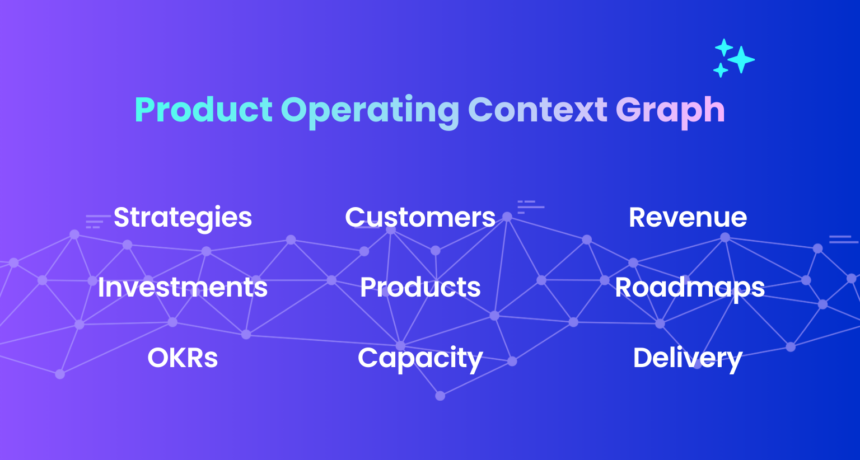
Executives, product leaders, PMs, engineering, and GTM teams all participate in decisions with different priorities and data views. A shared, live context graph ensures every role works from the same decision-ready model, while AI helps surface relevant context at the moment of decision. - Make Prioritization a Continuous, Data-Driven Activity
Prioritization is inherently a portfolio problem, balancing opportunities and constraints across teams and goals. Tooling that combines real-time context with AI-assisted scoring and tradeoff analysis lets teams evaluate options faster and with greater alignment. - Enable AI-Assisted Scenario Planning
Static quarterly planning is too slow for dynamic markets. With AI-powered simulations over live portfolio data, teams can model “what-if” scenarios, visualize downstream impact, and adjust plans dynamically without manual spreadsheet work. - Detect Drift and Recommend Adjustments in Real Time
Plans inevitably diverge from execution due to scope shifts, dependencies, and new work. Embedded AI continuously monitors context, flags strategic and execution drift early, and suggests corrective actions so teams can course-correct before outcomes suffer. - Connect Delivery, Outcomes, and Go-To-Market Execution
Value is realized not at delivery alone, but when outcomes are captured in market adoption. Shared tooling with live context ensures delivery, adoption, and commercial impact are visible together, and AI can surface signals that warrant prioritization or go-to-market adjustments.
Platforms like Dragonboat provide a shared decision context graph based on a product portfolio operating ontology. This portfolio intelligence allows embedded and ambient AI agents to reason over live context, surface tradeoffs, detect drift, and recommend adjustments as conditions change.
Key Takeaway
Strategy, product, and portfolio are often treated as separate domains—but in practice, they are inseparable parts of how product organizations operate. The separation is often forced by existing toolings.
Teams already use AI to move faster on individual tasks. But driving outcomes faster at scale requires a different foundation: shared, live portfolio context that supports collaborative decision-making across roles, with humans and AI operating together.
Running product at scale with speed requires treating that portfolio context graph as core infrastructure.
Want to see it in action? Book a demo with our product experts.